Friday, October 6, 2017

Travel Entry - Experiencing the 'Seoul' of South Korea

This past weekend, Kaz and I spent three fun-filled days exploring Seoul, South Korea. We'd booked our trip months before all of the safety concerns had arisen; and, after much thought and consideration, we still decided to go - as there really weren't any more concerns in Seoul than in Japan or the US.

I'm not sure what I was expecting Seoul to be like - but it definitely felt to me like a mix of Japan and the US wrapped up into one. The city was clean, the public transit was convenient (and on time), there was food everywhere (both restaurants and street food), and each little neighborhood we visited had an entirely unique and different feel. Compared to Tokyo, the city felt less busy and less congested; yet, it still had a vibrancy and energy about it. I found the people to be a bit more outwardly expressive than in Japan (but perhaps not quite as much as in the US). The clothing styles were brighter and more unique, the people in general were louder and less reserved, and there was a slightly (and I mean slightly) more chaotic feel to the city. I was expecting to see a lot more foreigners, but there seemed to be way less than in Tokyo or other major Japanese cities. This might have been due to recent world events however - and the fact that we were visiting during a non-peak travel time. On many occasions, groups of kids yelled 'hello' to me and several complimented me ("You pretty") and even asked for my autograph! Talk about a self-esteem boost! :) Despite there being less foreigners, there was WAY more English - people were more willing to speak it (when necessary) and most places had signs and menus in English (which made getting around and understanding much easier for me - even though Kaz surprised himself with how much his Korean language skills came back to him...I don't know how he does it?!).


I think I was also expecting there to be more signs of the current situation in North Korea...and there really weren't any. Life in Seoul seemed normal...to say the least. One of our tour guides commented on the fact that we were all brave to come to South Korea to visit - given how Korea must look to the rest of the world. And yet, he mentioned that daily life for everyone in South Korea hasn't really changed. The thought and possibility of a potential attack is simply part of their daily life. Little reminders like 'shelter' signs on the subways (which are built much deeper in the ground - so they can also act as bomb shelters) and cabinets housing gas masks interspersed among the vending machines were really the only indications of a potential situation (if you didn't watch the news or weren't aware of current events).


I was also surprised that on many occasions, Korea's dislike of Japan was mentioned. I mean - in most cases it was in the context of talking about past wars and invasions...but at times it felt a bit 'in your face.' For example, when we were riding the train from the airport to our hotel - there was a video playing about an island that Korea and Japan both believe belongs to them. The video made statements about Japan lying, etc. and the directness surprised me a bit. As I write this, I realize that the US news is filled with comments like this about various countries - so it's really not that rare; however, perhaps my time in Japan (where people may have these types of views but not state them openly) has 'reverse jaded' me a bit.  

Our trip can be divided into three main parts - exploring the historical sites; exploring the food and city life; and, our tour to the border area of North and South Korea. Definitely three very different types of activities in just three short days; however, I feel like this variety really helped us to 'get a good feel' of Seoul!

Exploring the Historical Sites of Seoul
Most of our day on Friday was spent exploring the Royal Palaces of Seoul. There are four main palaces - Gyeongbokgung Palace, Changgyeonggung Palace, Changdeokgung Palace and the Secret Garden, and Deoksugung Palace. And, one Royal Shrine - Jongmyo Shrine.

Changdeokgung Palace is probably the most popular of the palaces as it is relatively well-persevered and is representative of Korean palace architecture. Additionally, the Secret Garden of Changdeokgung is said to be one of the most attractive places in Korea and the complex was named as a UNESCO World Heritage Site in 1997. The Secret Garden reminded me of Meiji Jingu in Tokyo in that as you are walking through the beautiful greenery - you completely forget that a major metropolitan city is bustling outside the walls!

Jongmyo Shrine houses the spirit tablets of the Joseon Dynasty (the last dynasty in Korea) kings and queens and is the venue for ritual ceremonies to them. The two buildings are quite long and narrow - and each room is said to hold a tablet for a specific person or family.

Here's some pictures of the palaces, garden, and shrine. You'll notice that while aspects of the architecture seem to have a Japanese influence, the palaces are much more colorful like they tend to be in China. Korea really does seem to be a mesh of Japanese and Chinese influences. 
On our walk from one palace to the next, we wandered through Bukchon Village. Bukchon Village has the largest cluster of privately owned traditional Korean wooden homes (hanok) in Seoul. It was fun to wander through the alleys and feel like we were being transported back into 'the olden days.' I was also impressed by how closely the new houses being built resembled the restored houses.
After a full day of exploring and a full evening of eating, we decided that the best thing to do at 9pm was to hike up a mountain to get a night viewing of Seoul. So, up and up and up Mt. Namsan we went! Mt. Namsan and the N Seoul Tower provided some pretty amazing views of the city at night...and we took the cable car down after hitting the 34,000 steps in a day mark! 
A Trip to the JSA (Joint Security Region)
While we were researching our trip to Seoul, I'd read that one of the top recommended things to do was to take a tour of the DMZ (Demilitarized Zone) or JSA (Joint Security Area) to learn more about the historical and current conflicts with North Korea. Kaz and I went back and forth about the idea - especially given recent events. However, in the end - our curiosity and desire to develop a better understanding of global issues won out. Plus, we knew we could cancel our tour if we changed our minds.

Before I talk about our experiences, here's a bit more information about the DMZ and JSA. To be honest, I didn't know much about either before we visited. The DMZ is a strip of land running across the Korean Peninsula that serves as a buffer zone between the Democratic People's Republic of Korea (North Korea) and the Republic of Korea (South Korea). It was created by an agreement between North Korea, China, and the United Nations in 1953 and is 160 miles long and 2.5 miles wide. Housed within the DMZ is the JSA - a meeting point between the two nations housed in a small area near the western end of the zone. The JSA is where negotiations take place between the two countries. Hopefully this helps explain things just a bit. 

On Saturday morning, we boarded a bus with about 50 other tourists from all over the world and headed to the JSA. Our bus drove on a highway that at many points seemed to 'hug' the boarder between North and South Korea. And, for long stretches of time, barbed wire fences with security huts lined the roads. There were also several moments in which we were able to look at North Korea in the distance - its sparse landscape looking markedly different from the skyscraper-dotted skyline of Seoul.

Our first stop was at a park (Imjingak Resort), which marked the most northern point that people could travel to without needing additional approval. Imjingak was built in 1972 to console those who are unable to return to their hometowns/families in North Korea; and, with the hope that someday unification will be possible. I'm not sure why I thought that South Korea's view of North Korea would be negative - but it definitely wasn't. Sure, they don't agree with the leader or current situation, but the overall desire is definitely to be unified as one country. One of the most emotional aspects of this park was the barbed wire fences covered with ribbons containing wishes from South Koreans to North Koreans. It's such a stark contrast of hope and war occurring simultaneously.


Imjingak also contains The Freedom Bridge. In 1953, after the Korean War, more than 12,700 prisoners of war returned to South Korea (the land of freedom) over the bridge. The bridge still connects North and South Korea; however, a wall has been built to separate the two nations. Visitors can walk up to the wall, which is covered with messages for Korean Unification.

After visiting Imjingak, we boarded the buses and headed north. At this point, we had to pass through many security checkpoints before we were allowed to go any further. There were military personnel everywhere, barricades covering the roads that the buses had to weave in and out of, and a military member came onto the bus at many points to check our passports. We were also strictly prohibited from taking pictures unless in very specific areas. Our guide told us that in South Korea, every male must serve a minimum of 21 months in the military. Many will serve right out of high school, while others may start college and then choose to serve their term. In North Korea, military service comes with a 10-year minimum commitment!

Next, we stopped at Camp Bonifas for a short briefing and to transfer to JSA-approved tour buses (for obvious security reasons). Camp Bonifas is home to the United Nations Command Security Battalion - Joint Security Area, whose primary mission is to monitor and enforce the Korean Armistice Agreement of 1953 between North and South Korea. I've never been on a military base, but this area felt like what I imagine a small portion of a base might feel like. There was an office building (equipped with a gift shop - which felt odd to me), a church, some athletic fields, and some residences that we could see...most of the other buildings were off in the distance a bit. There were also a strong US military presence and we learned that both South Korean and United States Forces Korea soldiers (known as "security escorts") conducted tours of the JSA and surrounding areas.

Our permission slip
Then, we boarded the buses and headed to the actual Joint Security Area. Once we arrived, we were instructed to line up in two lines and follow our leaders. We walked through a building and once outside we had to stay in two lines. We were told to turn and face North Korea (we could see one North Korean building with a guard) and were given about 60 seconds to take pictures. We were not allowed to walk down the steps and we were strictly (and I mean strictly) prohibited from pointing or making any hand gestures toward North Korea - as the guards might think we were taunting them. For someone who moves my hands a lot - I was so nervous that I kept them in my pockets just in case! While the pictures show many military men - they are all South Korean - and there to protect the visitors and tour groups. I asked our guide why we only saw one North Korean guard and he said that it was because there were no Northern Korean visitors touring the other side. He's been working at the JSA for 15 months and noted that he'd only seen an increase in North Korea military about ten times (not counting when there were official meetings/business between the two countries). This surprised me - because for some reason, I was imagining a large military presence from both sides at this location.

Pic taken from North Korea
After taking a few pictures, we were lead into the conference room. The building is shared by both countries and half of the room is in North Korea and the other half is in South Korea. A large table marks the center of the room and when meetings occur - members sit on their respective sides of the table (and country). Within the conference room, we were allowed to walk around - which gave us the opportunity to say that we actually 'set foot' in North Korea. We were also allowed to take pictures with the military members (all South Korean). You'll notice that they all wear sunglasses. This is to prevent the two sides from having 'eye wars' and also decreases the amount of human connection that occurs between the North Korean and South Korean soldiers as they spend a lot of time looking over the boarder at each other. After about two minutes in the conference room, we boarded the buses, and headed back to Seoul (via a quick stop at Camp Bonifas and lunch outside the walls of the JSA and DMZ zones).

Our tour was also supposed to include a stop at the Bridge of No Return, which is where prisoners of war were given the choice to either remain in the country of their captivity or cross the bridge to return to their homeland (North Korea). However, just days before our tour - it was discovered that North Korea had built landmines in the areas surrounding the bridge (needless to say - the bridge is no longer part of any tour).

While there were obviously many risks associated with this tour, and I was rather nervous in general, I have to say that at no time did I feel unsafe. Sure, a part of that was probably innocence, ignorance, or whatever you want to call it...and, at the same time...everyone understood the seriousness of the situation and was prepared to act if needed. Even to the point that we were required to wear closed-toe shoes in case we had to run. In light of the recent incident in Las Vegas (less than a week after this trip), I've been thinking a lot about the concept of safety. So many people have said to me - 'I can't believe you went to Korea' or 'That was risky.' And, while I clearly see their points...I can't help but wonder...is it better to be in place with safety concerns at hand (and protective measures in place) or a place where something like a shooting can break out at any moment with no warning? Lately, the later seems almost scarier to me.

Since I don't want to end my post on a heavy note, I'll end with a summary of our food and city adventures! :)


Food and City Stuff
In addition to the historical sites, Seoul is also known for food and shopping. And boy, are there a lot of both! Throughout our time in Seoul, we explored more neighborhoods than I can count - each with its own vibe and personality. Myeong-dong is known for its cosmetics and street food; Insa-dong is known for its traditional goods; and, Gangnam is known for its high-end department stores (and the dance!). We also visited Common Ground, which is a pop-up area made out of shipping containers. This was one of my favorite places! While I'm not the biggest shopper in the world, I did enjoy browsing the shops - especially Lotte Mart - a huge grocery store with lots of free samples! I may have stocked up on seaweed, tea, instant coffee, and lots of snacks! :)
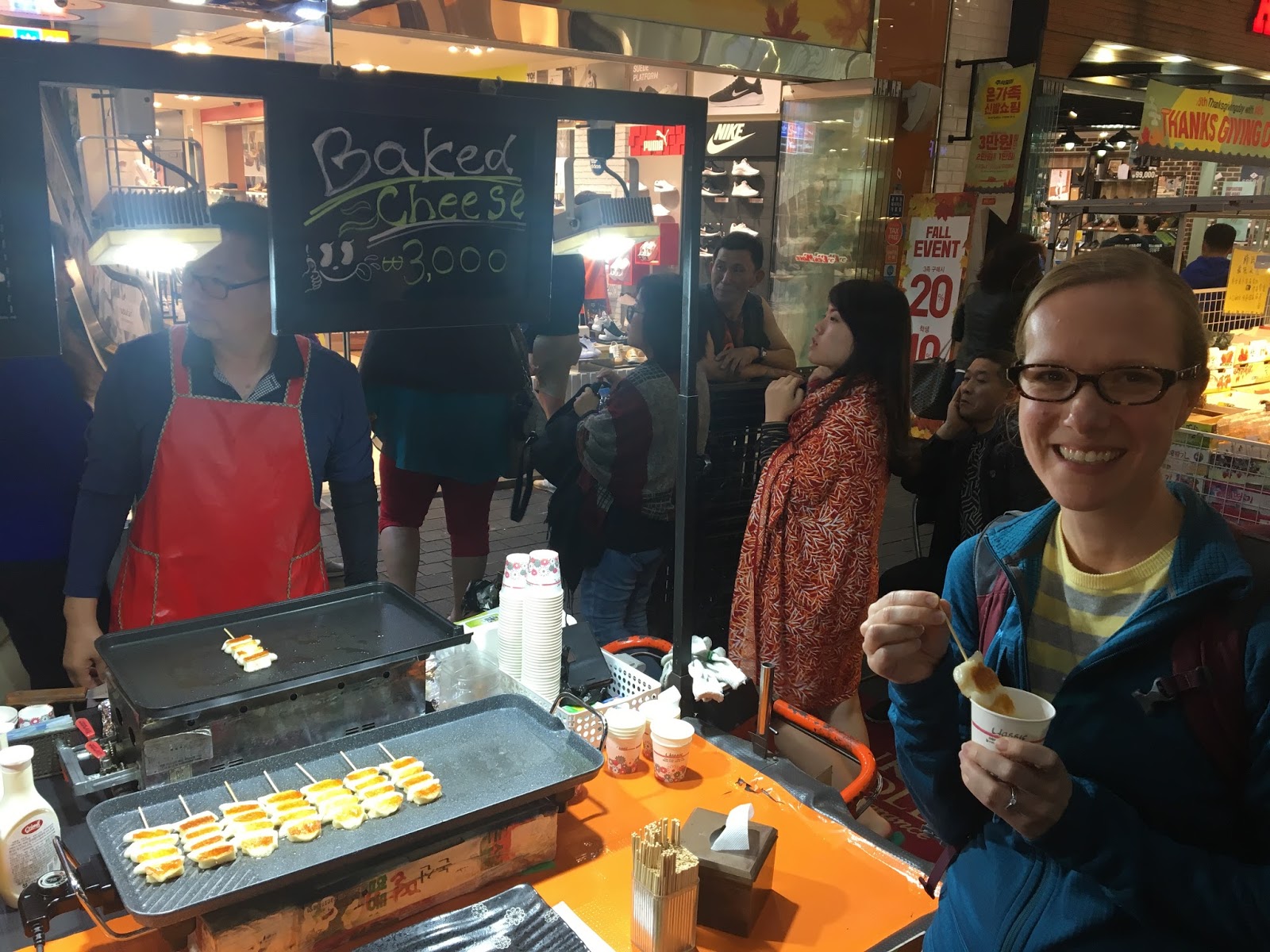
When it comes to food, Seoul's got it all - delicious street food, traditional restaurants, hip diners, yummy bakeries, and more coffee shops than I've ever seen in one place in my life. And boy, do I love coffee shops. There must have been one every 50 feet or so...literally! I'm not sure how they all stayed in business. Some of our favorite meals included bibimbap (a rice dish with veggies and meat), dumplings (much larger and stuffed with more goodness than in Japan), and Korean BBQ (where you get to grill yummy meats and vegetables at your table). The food was definitely spicier than I'm used to - so I struggled a bit - but it was definitely hearty and delicious! I also tried banana milk, which is apparently really popular and sold everywhere. It tasted just like someone had soaked a banana laffy taffy in milk - quite artificial at first, yet oddly more and more delicious with each sip! Here's lots of food pics! :)
Despite some initial worries, Seoul was a really neat city to visit. As with most of our travel experiences, I'm impressed by how much we were able to see and do in such a short time! Seoul was definitely a nice 'last international stop' for our time in Japan; however, I'm definitely adding Korea to my list of places to visit again and explore more of in the future! 

Friday, September 22, 2017

The Japanese Bathroom: Everyday Differences - Take 7!

Yes, I know that the title of this blog post sounds rather funny; however, the entire Japanese bathroom experience is slightly different here in Japan. And, I'm not even talking about the onsen aspect - as that has a blog post of its own. In addition to multi-flavored Kit Kats, beautiful teacups, and awesome stationary supplies, most of our guests have left Japan wanting to bring back both a Japanese toilet and a Japanese shower room with them. And, I couldn't agree more. I've already started to brainstorm how I will be able to make this happen. The toilet is looking much more promising than the entire shower room. 

I should start out by stating that even though the bathroom culture in Japan seems a bit futuristic, it's the way it is because it originally fit the needs of the Japanese people (and has evolved and modernized from there). Japan is a country that prides itself on creating little waste - especially since it's an island and the waste has nowhere to go. So, water was something that was highly valued, hard to come by, and important to conserve. Hence the creation of public baths (onsens) and then eventually the sharing of bath water among all family members. Many bathtubs now actually connect to the washing machines so that the bath water can be recycled and used to wash clothes. And, many toilets also have sinks on top of them and the water used to wash your hands then fills the toilet bowl for the next person to use.

Japan also has a strong desire to separate clean and dirty, thus the existence of what I call the 'toilet room' and the 'shower room.' And the slippers to be worn only in the toilet room. Seeing a trend? 

~*The Japanese Toilet*~
The Japanese toilet is one that needs to be plugged into a wall, which is the hurdle that most foreigners run into when trying to buy a Japanese toilet for their home. It often involves an electrician needing to add an outlet (and all that is involved in that process). The reasoning for the power is that not only does the Japanese toilet have a heated seat (with several settings), it also has multiple different features (which come with a control panel and lots of buttons). Things like automatic seat opening/closing...just imagine walking into your bathroom and the seat opens automatically; bidet...which includes normal mode, woman mode, and many option for personalization; and, sound...in which the sound of running water begins to play to disguise any unintended sounds. 

I'm not going to lie, the first time I used a Japanese toilet, I was rather intimidated. Not only were there tons of buttons, they were all labeled in Japanese. Just imagine making some kind of ruckus in the airport bathroom less than ten minutes after arriving in Japan. Luckily, the toilet in our bathroom has been labeled in English...so I've had some time to learn and memorize the various buttons and features. And, I've also noticed that in most public places - the 'flush' button is much bigger and/or labeled in English just in case. On one occasion, though, shortly after arriving in Japan, I may have hit the bidet button instead of flush - and ran out of the bathroom as quickly as possible...hoping that no one would immediately enter and realize that I was the one who'd gotten water everywhere! 

Obviously, Japanese toilets at home are usually clean; however, unlike in the United States, public bathrooms in Japan tend to be clean as well! No more having to wait until you get home! And, the toilets in public places are usually equip with all of the features of a home toilet. The one thing that I still don't understand though is the rather huge contrast between these toilets and the squatty potties. They really do seem like two extreme ends of the spectrum in my book! 

I think the Japanese advertisement for toilets are almost as amazing as the toilets themselves. Here are just a few for you to enjoy! The first two teach you how to use the toilet (toilets here actually do come with user manuals) and the third is a commercial in which a father and child (dressed up like germs) are trying to find a place to stay on the toilet...but failing because it's too clean! And if you want even more, Google 'Toto toilets' and check out just how happy every person on the website looks! 


~*The Japanese Shower Room*~
Down the hall from our 'toilet room' is our 'shower room!' It's actually one big wet room and it's amazing. The room has a shower area and a bathtub - and you can get the entire room wet because there is a drain in the middle. And, you don't actually have to stand in the bathtub while taking a shower - which we've forgotten to tell most of our guests until they ask us! I think this would be a dream with children as you would be able to put them in the room and hose them off without making a huge mess! Plus, they would be able to splash as much as they wanted in the bathtub because it wouldn't matter whether the floor got wet. It's also a breeze to clean as you just go in, hose it all down, and give it a good scrub without worrying!

Japan's separation of clean and dirty also carries over into the shower room as well. Typically, one will shower and then soak in the bath. The bath water also tends to be shared by an entire family - because one is clean when entering the bath. I know, this part seems odd to many. 

While we typically only shower, a nice long soak in the bath every once is a while is amazing. The bathtub is also so deep that you literally sink into it. Plus, when filling a bath (which of course you do by hitting a button on a control panel in the living room - and waiting for a pleasant musical tune to play to signal it's ready) - it fills all the way to the top...so much so that when you get in and sit down - the water overflows onto the floor. Our bathtub also comes with a lid - to keep the water warm in case we want to use it again later. Or, we can also turn on a function to warm the water if its gotten too cold.

Unlike in the United States, bath salts are not viewed as dangerous items. In fact, they are very common and the Japanese love their baths to smell wonderful. Lavender, pine, onsen, eucalyptus, you name it - they've got it! The bath salts also turn your bath water bright colors - just to enhance the experience. Who doesn't love a bright purple bath?! 

The shower room also acts as a sauna (you can select sauna mode) and as a drying room (since most Japanese households don't have dryers). You hang you clothes, shut the door, and turn the heat up high and even your jeans can be totally dry in about two hours. For some weird reason, I waited almost a year before I began drying clothes in the shower room...what a lost opportunity! 

I'm sure this blog post has left you wanting to come to Japan just to experience the bathroom culture...or googling Toto toilets to see how you can get one! As the clouds begin to roll in, and the rain begins to fall...I think I'll run myself a bath...as soon as I fold all the clothes currently filling my shower room! :)

Wednesday, September 13, 2017

Safety: Everyday Differences - Take 6!

In light of recent events, and the realization that I'm living in a country just a little too close to North Korea, I decided that safety would be a fitting topic for this month's blog post. Safety is something that I've spent a lot of time thinking about how much I don't think about since moving to Japan. Got that?! 

According to the 2017 Global Peace Index, Japan is the 10th safest country in the world. Just for comparison, the United States was ranked 114th. The index gauges global peace using three broad themes: the level of safety and security in society, the extent of domestic and international conflict, and the degree of militarization. Japan was ranked 3rd until 2007 and has been slowly increasing since then - perhaps due to the rise in international conflict with North Korea and the increase in tourists visiting the country. 

I have to preface this post by saying that I didn't consider my life in America unsafe; however, safety was often on my mind. In America, the individualistic cultural perspective can often lead to everyone looking out for him/herself. Whereas, in Japan, the collectivistic cultural perspective creates an environment in which everyone believes they have the responsibility to watch and look out for each other. Now, one perspective isn't necessarily better than the other, they are just different...and have a definite impact on people's actions and behaviors. In America, we worry about our valuables being taken or walking alone at night; in Japan we worry about whether our neighbor will look through our trash and tell us we sorted it incorrectly! 

While I have many, here are just a few examples of the way my daily life is different in Japan when it comes to safety.  

**In Japan, people hold their spots in public places using valuables.** 
https://www.lifewhereimfrom.com/
When walking into most public places with seating, you'll see phones, laptops, purses, cameras, and other valuables scattered upon tables and chairs with their owners nowhere to be found. The valuables are used to claim a space while a person orders food, runs to the bathroom, or even stops quickly in a neighboring store. And, on almost all occasions (there are bad people everywhere), the valuables are there when the person returns...untouched and often unnoticed. 

I have to admit that at first, I was rather hesitant to leave my belongings; however, I quickly embraced this behavior...and didn't realize how normal it had become to me until my dad and Sherri came to visit. When visiting one of my favorite cafes, I placed my backpack, purse, and computer on the table and told them to the do the same while we went back downstairs to order. My dad and Sherri looked at me with surprise...and it took some convincing before they were hesitantly willing to leave their belongings too. To their surprise and relief, their belongings were still there when we returned. 

I've also heard many stories about people who've left purses, wallets, or laptops on the train...and the items are almost always turned in with everything just the way it was left. While I would have found that surprising and considered myself lucky in America...it's the norm here in Japan. It's also common to see people sleeping on benches, lawns, stairwells, and even the sidewalk after long nights of drinking. Most of the time, people will pass by without giving the person much thought. They may move them to a safer place (off the sidewalk and onto the lawn), but they would never think about taking the person's belongings even if they were easily accessible. 

Here's a fun YouTube video about this very observation. 

**Young children travel on their own.** 
One of the first things that I noticed when coming to Japan was that most of the children that I saw out and about were on their own. Walking downtown, riding bikes, taking the subway, riding the bus, shopping in the grocery stores, etc. And these children weren't nine or ten...many of them couldn't have been more than five years old. Sure, I played outside as a child and rode my bike to my friend's house; however, I can't even imagine heading off to kindergarten via subway, train, and bus on my own! Let alone in a city the size of Chicago! 
Kaz and I watched a show once in which parents worked with a camera crew to give their children a chore/job that required the child to travel across town alone, complete the task, and then return home. The children were three years old, and while the camera crew was set up secretly to keep an eye on the children (and to record their journey), all of the children completed the journey with little to no difficulty. I remember thinking...I don't think I would have even had the skills or maturity to complete a task like that at three years of age! However, I suppose you adjust to what you know!

Last week, I was out to lunch with a friend right before her family returned to America. We were at a food court and her children were asking to go off and look around on their own. She replied - Yep, go ahead...because once we're back in America...you won't be able to leave my side. And, in that moment, I realized just how much we've all changed our view on safety since arriving in Japan. 

**I travel on my own.** 
Since I don't drive in Japan, I rely on public transit or my feet to get me just about everywhere. And, GoogleMaps, which I would be absolutely lost without! While I am obviously aware of my surroundings, I give little thought to the fact that I am often traveling to a place I've never been before. More often than not, I know nothing about the neighborhood - and yet, I can only think of a few times when I wondered if it was going to be in a 'bad area.' Sure, every city has some 'questionable' areas (e.g., red light districts); however, questionable doesn't usually equate to unsafe - especially if you're just walking through. Crime, drugs, and even the mob all exist in Japan - you just have to be in those crowds to find the trouble. 

This past summer, a friend of mine and I went on a quest to find a beach. We looked up some spots and jumped on the train. We got a bit lost walking from the station to the beach and found ourselves literally wandering up and down random streets and alleys. I remember thinking to myself - where else have I been where I can just wander around an unknown place and have my only worry be that I might be a bit later than I expected! Living in Japan has definitely come with many challenges; however, the ability to come and go as I please (safely) has not been one of them. Even at night! 

**Police officers don't carry guns.** 
Kaz and I often joke that Japan's idea of heightened security is the police officers in Nagoya Station standing on stepladders. However, it's not far from the truth. I don't think I've seen a single police officer carrying a gun since we've arrived in Japan. And, because Japan doesn't allow guns as a whole - gun violence is something you rarely, if ever, hear about. 
Because of the lack of guns, almost all crimes in Japan are premeditated. People really have to plan if they want to hurt someone. If we hear about crimes, they are usually poisonings, assaults, or rather strange and often gruesome murders. 

My Japanese teacher told me about a story that was in the Japanese newspapers a few years ago. As it was extremely shocking and unheard of in Japan. A Japanese student was studying in America and had planned to attend a Halloween party with his friends. He made a mistake and walked into the wrong house. The person yelled for the student to get out, but the student froze because he didn't understand the language. And, the man ended up shooting and killing the student. I'm not sharing this story to make America sound bad, I just thought the comparison was a powerful one. Seeing as one of my friends, while visiting me in Japan, mistakenly walked into a random person's house while trying to find the inn she was staying at. The person looked at her with confusion; however, he stood up and escorted her to the inn next door. While it seems like she may not have been the first person to make this mistake - the differences in outcomes is a poignant reminder of how our environment can shape our actions.  

On a slightly more humorous albeit useful note, I've also realized that Japan tends to advertise that the safety found here may not be found in the rest of the world. Recently, my vocabulary during my Japanese lessons have centered around words used in emergencies, crimes, and accidents. The chapter also included a picture of things that could happen while traveling abroad. I'm not going to lie...I definitely giggled a bit; however, I suppose it's better to be safe than sorry. 

While there are many aspects of safety that I don't have to think much about in Japan, there are other aspects of safety that I've had to adjust to. For example, earthquake safety is big in Japan. I realized the first time that my phone went off making a loud noise and messages popped up that I couldn't read...that I didn't know what to do if an earthquake occurred. After doing some research, locating our disaster pack, and determining the location of the nearest evacuation area, I feel a little more prepared. But still hope that I don't have to experience a major earthquake while I'm here. Since I'm not a city girl, I've also had to adjust to living in a big city. Things like watching where I'm going at all times; dodging bikes, cars, and crowds of people; and, using my other senses since I often cannot read signs or understand what people are saying have been really important. I have to say that bikes are definitely one the scariest things here in Japan - especially in the areas where there are crowds of people at all times. Talk about giving your 'fight or flight' reflexes a run for their money. 

The purpose of this post is definitely not to prove that Japan is safer than America; instead, I was hoping to share the ways in which my daily life is a bit different than at home. While writing this post, I've also realized that most of the examples I've discussed fall under the criminal aspect of safety. However, safety is a rather broad category and can also include things like mental health, physical health, etc. When it comes to Japan, bullying, suicide, and overwork are all very prevalent social issues. Additionally, I've noticed that people in Japan (especially children, teens, and young adults) tend to be oblivious to their surroundings at times. On so many occasions, I've had to jump out of the way because someone was walking and texting or biking and texting...and not even glancing up to watch where he/she was going. I've also noticed that people here tend to stop while they are walking without looking around first. Crowd traffic will be flowing and then someone will stop for some reason and everyone will have to jump out of the way. I've had more than my fair share of near misses! I guess this just goes to show that we often acclimate to our environment and not always in a positive way! 

I'm going to leave you with an ACTUAL video clip from the 80s meant to teach Japanese people the ten most important English phrases to use when traveling abroad. I'll let you formulate your own thoughts and opinions. I find it hysterical...and yet, it does shine some light on what Japan thinks of the rest of the world. And, more importantly, the fact that safety differs everywhere you go - and it really helps to read up a bit before you go!